
According to a profile piece in Time magazine, Hugo Gernsback first thought up the idea of a tv headest in 1936 but ditched it as he thought it would be to be too impractical. He was said to have ordered employees to build a prototype of his “teleyeglasses” which weighed 140 grams and ‘were built around small cathode-ray tubes that ran on low-voltage current from tiny batteries’ according to IEEE Spectrum. They never went into production, however its quite interesting to see that the concept was being explored before there was even a slight possibility of a fully functioning vr headset.
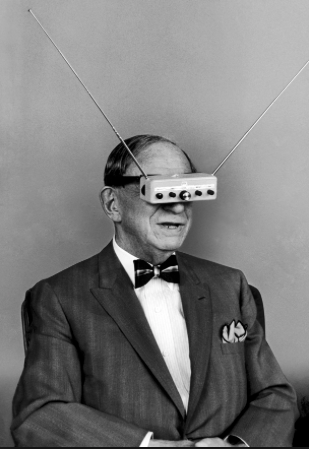
A similar method has been used since the 1800s to display 3D images using stereoscopic viewers. This involved looking at two near-identical images side by side, which when viewed through a viewer appear to show a 3D scene.
This also brought me to X-ray vision glasses that supposedly gave you X-ray vision which kids in the 1960s/70s, so around the same time as the teleyeglasses, grew up with being advertised all around them.
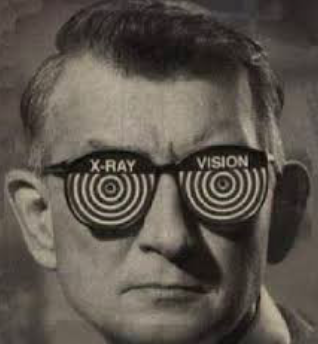
X–Ray Specs are an American novelty item which were meant to allow the user to see through or into solid objects. In reality the glasses merely create an optical illusion. The “lenses” consist of two layers of cardboard with a small hole about 6 millimetres in diameter punched through both layers. The user views objects through the holes. A feather is embedded between the layers of each lens. The vanes of the feathers are so close together that light is diffracted causing the user to get two slightly offset images. For example, if your looking at a pencil, you would see two offset images of the pencil. Where the images overlap, a darker image is seen, supposedly giving the illusion that your seeing the graphite inside the pencil. As you would imagine, the illusion is not particularly convincing 🙂

 georgia colson :)